Your IT is either working for your business or against it. Rarely anything in between. If tech issues keep coming up, your setup feels like it’s held together with good luck, or you’re not sure whether your systems are actually secure. This is worth a few minutes of your time.
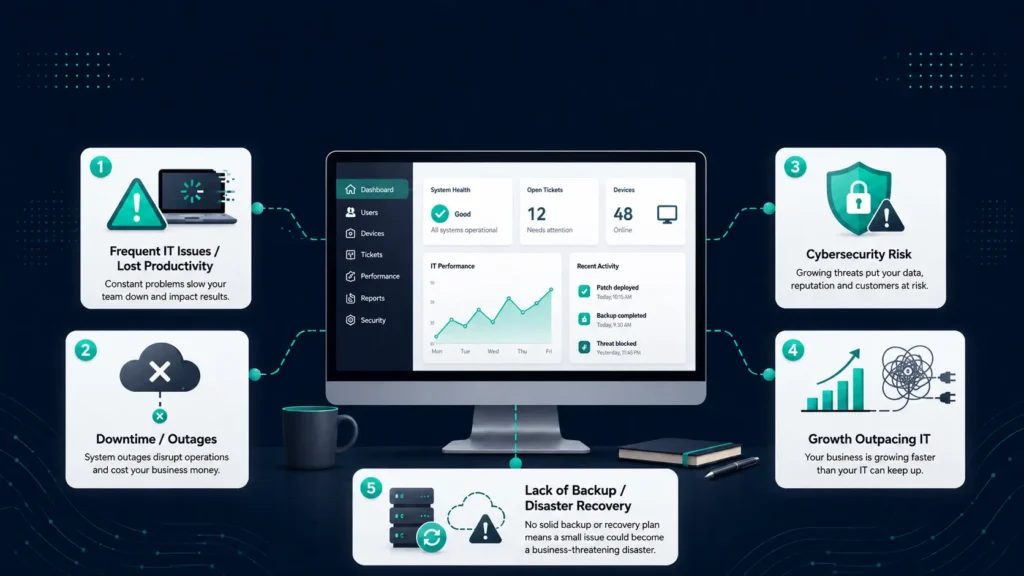
Sign 1: IT Problems Are Eating Into Your Working Day
You didn’t start a business to spend your mornings troubleshooting why someone’s laptop won’t connect to the printer. But that’s exactly what happens when IT isn’t properly managed.
It starts small. A slow machine here, a failed login there. Then someone’s email stops syncing, the shared drive goes down, and suddenly you’ve lost the better part of a morning chasing fixes that shouldn’t need chasing.
For a team of ten, losing just 30 minutes per person each day to avoidable IT problems adds up to over 1,300 hours a year. That’s time your staff could spend on client work, sales, or operations that actually move things forward.
Managed IT support takes that daily burden completely off your plate. Issues get spotted and resolved remotely, often before your team even notices something’s off. Your people come in, log on, and get on with their work. That’s how it should be. If it isn’t, that’s a sign worth paying attention to.
Sign 2: Downtime Keeps Happening
The odd hiccup is part of running any business. But if your systems regularly go down, even for an hour or two, the financial impact is real. UK SMEs lose an average of £4,200 per hour to unplanned downtime, and that figure doesn’t account for the longer-term damage to client relationships or your reputation.
The typical small business IT model is reactive. Something breaks, you call someone, they fix it. Until it breaks again. Nobody is watching in the background, there’s no early warning system, and there’s no proactive work happening to stop problems before they escalate.
24/7 IT monitoring changes that entirely. Server health, network performance, storage capacity, all tracked continuously, all day, every day. Problems get flagged and resolved before they bring anything down. Your business keeps running, and you don’t spend your afternoon on hold with a support line trying to get something back online.
Sign 3: Cybersecurity Feels Like Guesswork
“We’ve not had a problem yet” is not a security plan. According to the UK Cyber Security Breaches Survey 2025/2026 published by the UK Government, 43% of UK businesses experienced a cyber attack or breach in the past year (around 612,000 businesses in total). Phishing was involved in roughly 85% of those incidents.
Small and medium-sized businesses are not the safe option they used to seem. Attackers know that SMEs often run lighter defences than larger organisations, which makes them attractive targets. And the consequences go beyond the breach itself. Reputational damage, regulatory fines, and the cost of recovery can follow a business for years.
Proper cybersecurity is not a one-time box to tick. It means regular software patching, endpoint protection, email filtering, staff awareness training, and active monitoring for suspicious behaviour. If your current IT setup doesn’t include all of those things, or you’re not sure whether it does, that’s a clear signal that managed support is worth taking seriously.
Businesses in finance, healthcare, and legal services face additional pressure here. GDPR compliance, Cyber Essentials certification, and sector-specific regulations mean your security posture needs to be documented and auditable, not something you’re simply hoping is probably fine.
Sign 4: Your IT Hasn’t Kept Up With Your Growth
This one catches a lot of businesses off guard. Systems put in place for five staff members were never designed to support fifteen. File-sharing that worked fine when everyone was in the office starts showing cracks once half the team works remotely or travels between sites. Microsoft 365 is half-configured. Permissions are inconsistent. New starters get added to systems without any proper process behind it.
Most posts on this topic miss this entirely. The real trigger for managed IT is often not a dramatic failure. It is the slow accumulation of workarounds, rushed decisions, and IT choices made under time pressure with no long-term thinking behind them. Hybrid and remote working has accelerated this for a huge number of UK businesses over the past few years, adding layers of complexity that a reactive, break-fix approach was never built to handle.
When infrastructure grows through improvisation rather than intention, the whole thing becomes fragile. The more staff depending on it, the bigger the impact when something gives way.
Outsourced IT support gives you a team that reviews your full environment and builds an IT strategy around where your business is heading , not where it was two years ago. Cloud management, Microsoft 365 configuration, remote access, secure onboarding: all of it brought in line and kept there as your business grows.
Sign 5: You Have No Real Plan for When Things Go Wrong
What would happen to your business if your server failed tomorrow? Or if ransomware locked every file on your network? Most business owners have a rough idea, call someone, try to recover what you can. Very few have a tested, documented disaster recovery plan that’s actually ready to go.
This is the question that almost nobody answers in content like this. Signs of poor cybersecurity and the cost of downtime get plenty of coverage. What gets skipped is the practical reality of what actually happens when the worst occurs, and whether your business could recover, how quickly, and at what cost.
A managed IT provider doesn’t just keep your systems healthy day-to-day. They put a proper disaster recovery and business continuity plan in place, test it at regular intervals, and make sure your data is backed up securely with a clear, fast route to restoration. For regulated sectors, finance, healthcare, housing, legal: this is not a nice-to-have. GDPR requires documented, auditable processes for data protection and recovery. Getting it wrong after a serious incident brings regulatory consequences on top of everything else.
If you can’t clearly state what your recovery time looks like, where your backups sit, and who does what if your systems go down tonight, that’s a sign managed support is overdue.
Ready to See Where Your IT Actually Stands?
None of these signs mean your business is failing. But if two or more feel familiar, reactive IT support probably isn’t serving you as well as it could. The good news is that switching is simpler than most people expect.
Before you make any decisions, it’s worth reading 7 questions your business should ask before choosing an IT support partner so you know exactly what to look for. When you’re ready to talk, UK IT Services offers a free IT consultation, no pressure, no jargon, just an honest look at where your setup stands and what better looks like. Get in touch with our team today.