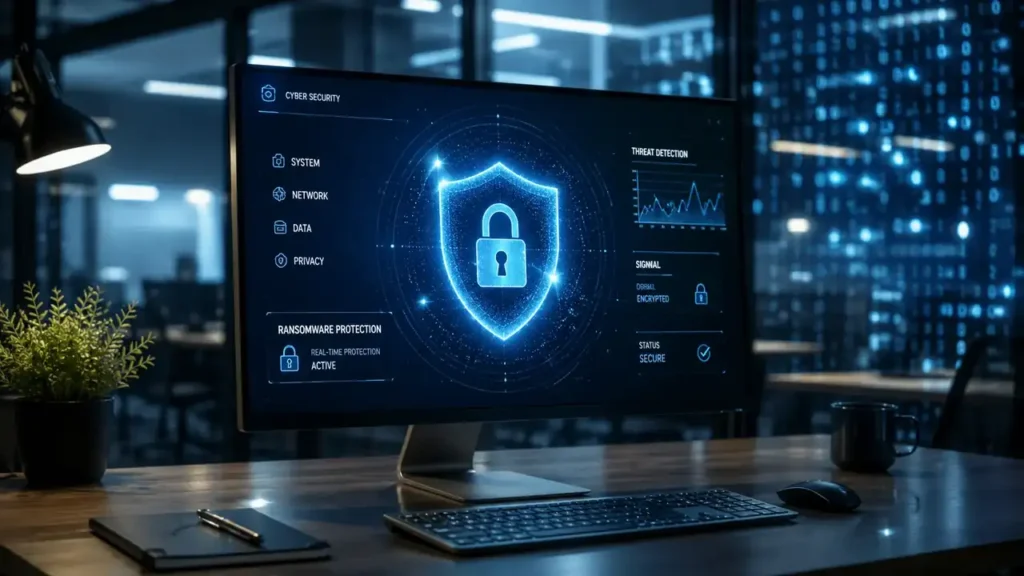
Ransomware does not discriminate. According to the UK Government’s Cyber Security Breaches Survey 2025/2026, 43% of UK businesses, around 612,000 organisations, reported a cyber attack or breach in the past 12 months. For many of those, ransomware was the cause, and recovery stretched from days of lost trading to fines from the ICO. This guide walks you through what ransomware actually does, how it gets in, what it costs, and the practical steps you can take right now.
What Ransomware Actually Does to a Business
Ransomware is malicious software that encrypts your files and demands payment, usually in cryptocurrency, in exchange for the decryption key. Once it is inside your network, it moves fast: files, folders, shared drives, and any backups directly connected to the network are all at risk within minutes of the initial infection.
Most businesses do not realise they have been hit until they try to open a file and find it locked. By then, the ransomware has already done its work. A message appears on screen demanding payment, often with a countdown timer designed to increase pressure, and the business grinds to a halt.
Modern ransomware variants also steal your data before encrypting it, a tactic known as double extortion. The attackers threaten to publish sensitive client data, financial records, or employee information publicly if you do not pay, turning a systems problem into a legal and reputational crisis at the same time.
Why UK Businesses Are a Prime Target
UK businesses are attractive to ransomware gangs for a straightforward reason: they hold valuable data, many carry cyber insurance which makes payment more likely, and a large number operate without dedicated IT security staff. SMEs are disproportionately affected; they often have fewer defences than large enterprises but hold just as much sensitive data about clients and employees.
According to the National Cyber Security Centre, ransomware remains one of the most significant cyber threats facing UK organisations, with attacks growing in both frequency and sophistication. Professional services, construction, and healthcare businesses are among the most frequently targeted sectors, all industries that UK IT Services supports directly.
How Ransomware Gets Into Your Systems
Understanding the entry points is the first step to blocking them. Sophos’s 2026 State of Ransomware report found that malicious email and phishing together account for half of all incidents, with compromised credentials and exploited vulnerabilities making up most of the rest. Taken together, 79% of attacks start with some form of identity-based approach rather than a purely technical exploit. The most common routes into a UK business are:
- Phishing emails. A staff member clicks a malicious link or opens an infected attachment. This accounts for the largest single share of ransomware incidents across all business sizes.
- Compromised credentials. Usernames and passwords from previous data breaches are used to log directly into your systems, often without triggering any alarm.
- Remote Desktop Protocol (RDP) exploits. Attackers brute-force or exploit exposed RDP ports, particularly common since the growth of remote working.
- Unpatched software. Outdated operating systems and applications carry known vulnerabilities that ransomware gangs actively scan for and target.
- Malicious websites. Visiting a compromised site can trigger an automatic download without any deliberate action from the user.
None of these entry points require sophisticated hacking. Most ransomware attacks succeed because of something simple: a single click, one unpatched system, or a weak password without multi-factor authentication behind it. That is actually encouraging; it means solid basic security stops the majority of attacks before they start.
What a Ransomware Attack Really Costs
The ransom demand is rarely the highest cost. Downtime, recovery, and legal consequences add up far more quickly. Sophos’s global 2026 research found the average recovery cost, excluding any ransom paid, reached $1.7 million per incident, against a median ransom payment of $769,000; recovery has consistently cost more than the ransom itself in every year Sophos has tracked it. Those are global, largely enterprise-weighted figures, but the pattern holds at UK SME scale too: rebuilding systems, replacing hardware, and lost productivity typically outweigh whatever the attackers were asking for.
Your legal exposure adds another layer. Under UK GDPR, if personal data is accessed or exfiltrated during a ransomware attack, you must report it to the Information Commissioner’s Office within 72 hours of becoming aware of the breach. Failure to report carries fines of up to £17.5 million or 4% of annual global turnover, whichever is higher. Many businesses hit by ransomware do not realise this obligation exists until it is already too late.
Add in reputational damage, loss of client trust, and potential contractual penalties for service disruption, and a single ransomware incident can threaten the long-term viability of a business that otherwise had a strong trading position.
Seven Steps to Protect Your Business Right Now
You do not need an enterprise IT budget to defend against ransomware. These seven steps address the most common attack vectors and significantly reduce your exposure.
1Follow the 3-2-1 backup rule
Keep three copies of your data on two different media types, with one copy offsite or in a separate cloud account with no direct connection to your live systems. Our Microsoft 365 backup guide covers what a proper backup actually needs to cover.
2Turn on multi-factor authentication
Add a second verification step to all accounts, especially email, remote access, and cloud services. Given that identity-based attacks now account for the majority of ransomware incidents, this alone stops most credential-based attacks. Our cyber security best practices guide covers MFA setup in detail.
3Keep software and operating systems patched
Apply updates promptly, particularly for Windows, browsers, VPN clients, and any internet-facing applications.
4Train your staff regularly
Phishing simulation exercises and brief monthly awareness updates are more effective than a single annual training session.
5Deploy endpoint detection and response software
Modern endpoint protection goes beyond basic antivirus and detects behavioural patterns that indicate ransomware activity before encryption begins.
6Restrict Remote Desktop Protocol access
If RDP is not needed, disable it. If it is, restrict access to specific IP addresses and require VPN authentication.
7Write an incident response plan
Decide in advance who does what if an attack occurs. The first hour is critical, and a written plan removes the paralysis that comes with shock.
Our cyber security services cover all of these areas as part of a fully managed approach, so your team can focus on the business rather than managing the threat.
What to Do in the First Hour of a Ransomware Attack
Most guides cover prevention. Very few tell you what to actually do the moment you realise you have been hit. This is the gap that costs businesses the most: panic, poor decisions, and delayed action all make the damage significantly worse. Here is exactly what to do in the first 60 minutes.
1Isolate affected machines immediately
Disconnect them from the network by unplugging the ethernet cable or disabling Wi-Fi. Do not shut them down entirely, as memory forensics may still be possible.
2Do not pay the ransom straight away
Payment does not guarantee a working decryption key, and it marks your business as one that pays, making you a target again.
3Contact your IT support provider immediately
Our emergency IT support line is available around the clock. Speed of response directly limits how far the attack spreads.
4Check whether your backups are intact
Verify that offline or air-gapped backups have not been encrypted. If they are clean, full recovery is possible without paying anything.
5Document everything
Screenshot the ransom note, record the time of discovery, and preserve evidence. This matters for insurance claims, ICO reporting, and law enforcement.
6Report to the ICO within 72 hours
If personal data has been compromised, you have a legal obligation to report it. Do not wait for full clarity; report what you know and update the ICO as more becomes clear. Our data breach response guide covers this step by step.
7Report to Action Fraud
File a report at actionfraud.police.uk to support national intelligence efforts and your insurance claim.
Access to 24/7 IT support means you are not handling this alone at 2am on a Sunday. Response speed is the single biggest factor in limiting damage after an attack begins.
Ransomware Prevention Checklist
- Backups follow the 3-2-1 rule, with at least one copy offline or air-gapped, and have been tested with an actual restore
- Multi-factor authentication is switched on for email, remote access, and every cloud service
- Operating systems, browsers, VPN clients, and internet-facing applications are kept patched
- Staff receive short, regular phishing awareness training rather than a single annual session
- Endpoint detection and response software is in place, not just basic antivirus
- RDP is disabled where it isn’t needed, and restricted to specific IPs with VPN authentication where it is
- A written incident response plan exists and the people who’d need to act on it know it’s there
How Managed IT Support Reduces Your Ransomware Risk
Prevention is always cheaper than recovery. A managed IT provider puts the controls in place before an attack occurs, and responds immediately if one does. Proactive monitoring means threats are identified before they spread, regular patch management closes the software vulnerabilities ransomware exploits most, and managed backup solutions ensure your data is recoverable without paying a ransom.
For small and medium-sized businesses, managed IT delivers enterprise-grade security at a fraction of the cost of an in-house team. Our managed IT support packages include cyber security as standard, endpoint protection, patch management, secure backups, and incident response, all covered under one predictable monthly fee.
Speak to us about a free IT security review. We will assess your current setup, identify the gaps, and tell you honestly what needs to change.
Frequently Asked Questions
Should I pay the ransom if my business is hit?
The NCSC advises against paying. Payment does not guarantee a working decryption key, and it marks your business as one that pays, making you a future target. Your first priority should be contacting your IT support provider, checking the integrity of your backups, and assessing whether free decryption tools exist for the specific ransomware variant.
Does cyber insurance cover ransomware attacks?
Most cyber insurance policies do cover ransomware, but coverage varies considerably between providers. Some cover ransom payments, others cover only recovery costs. Read your policy carefully before an incident, not during one. Many insurers also require evidence of minimum security controls before they will pay a claim, so it’s worth checking what standards your policy requires.
Is my cloud backup safe from ransomware?
Not automatically. If your cloud storage is mapped as a network drive or continuously synced, ransomware can encrypt cloud files just as easily as local ones. Safe backups need to be air-gapped or versioned, meaning older file versions are retained even when current files are overwritten. Ask your IT provider whether your backup setup meets this standard.
Am I legally required to report a ransomware attack?
Yes, if personal data was accessed or exfiltrated. Under UK GDPR, you must report a personal data breach to the ICO within 72 hours of becoming aware of it, and notify affected individuals if the breach poses a high risk to their rights. Failure to report can result in fines of up to £17.5 million or 4% of global annual turnover.
How long does recovery from ransomware typically take?
Businesses with clean, recent backups and a tested incident response plan can be back up within 24 to 48 hours. Without backups, recovery can take weeks and may not be complete. Backup quality, not just backup existence, is the single biggest factor in how quickly your business gets back on its feet.
How quickly can UK IT Services respond to a ransomware attack?
Immediately. Our helpdesk operates around the clock, and our emergency IT support covers incidents outside normal business hours. For businesses on a managed IT contract, response is typically within minutes. If you are not yet a client, call us; we will do everything we can to help contain the damage quickly.
Not Confident Your Business Could Recover From Ransomware?
Get a free security review and find out exactly where your gaps are, before an attacker does.
Ransomware is not going away. The threat keeps evolving, and the businesses caught out are almost always the ones that were not prepared. The steps in this guide are not complicated; most require no specialist knowledge to put in place. Start with backups and multi-factor authentication today, then get in touch to discuss a free security review for your business.